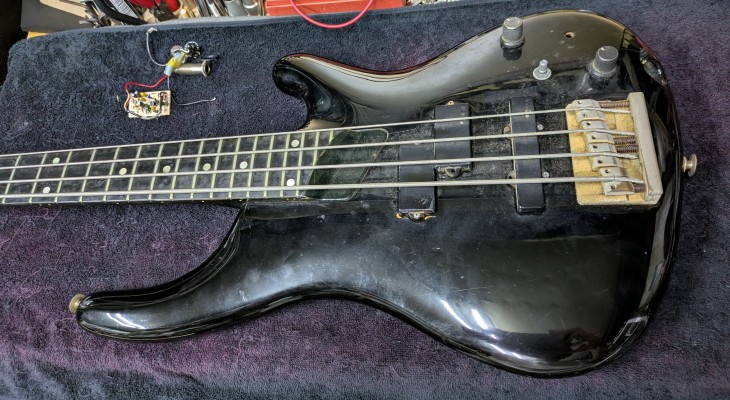
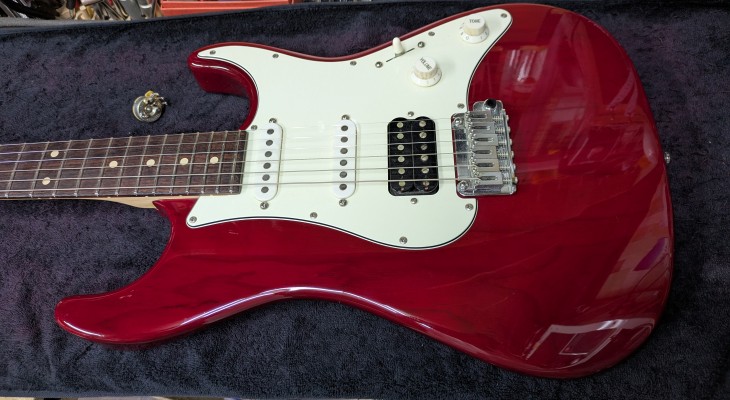
It’s in pretty rough shape and isn’t producing any sound.
Upon inspecting the interior, I found a broken jack and other parts that looked worn out, so I replaced them with new ones.
There’s also a special switch that’s broken.
It appears to allow you to switch the output path through the active circuit between two routes (presumably the standard route and a route that only passes through the buffer).
Since I couldn’t find an identical replacement switch, I decided to skip it and check the circuit board instead, but it appears the board itself is faulty.
Upon closer inspection, I noticed the board has switches labeled “Out 1” and “Out 2” for switching between outputs.
Even when I connected both directly to the jacks, no sound came out.
After consulting with the customer, I removed the circuit board and converted the unit to passive mode, which allowed it to produce sound without any issues.
Since the customer just wanted it to produce sound, I finished the repair by simply re-wiring it.
The neck is slightly bowing outward, making it a bit difficult to play.
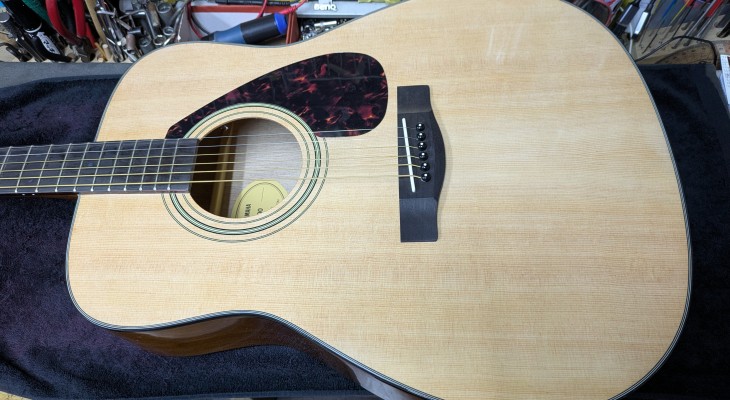
Although it’s a low-end model priced between 20,000 and 30,000 yen, it sounds fantastic—truly a testament to Yamaha’s quality.
I used to play a Yamaha acoustic guitar that I bought for around 30,000 yen that sounded amazing, and it seems the F600 is the model you can still get today.
After adjusting it, I found that the string action was on the low side for an acoustic guitar, making it very easy to play.
In the past, the nut height was high and the bridge string action was also high, so I used to have to adjust both of those points before playing. However, the current model is well-made in both respects and sounds great right out of the box, which is why it’s such a fantastic instrument.
I think this is more than enough for an acoustic guitar.
I understand you purchased this secondhand, but it’s in great condition.
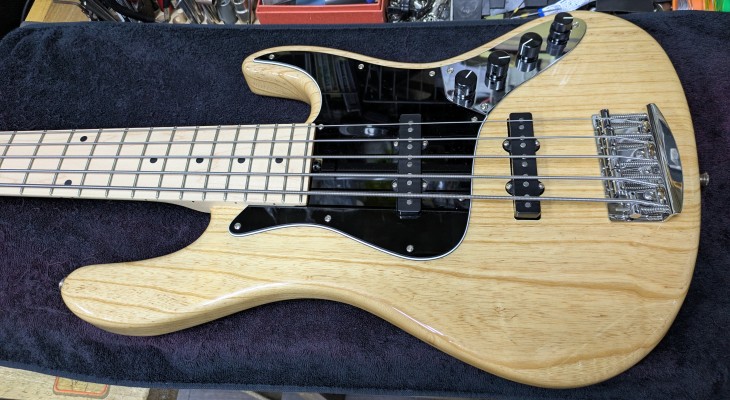
When I tried it out, it felt almost exactly like a Sadowsky bass.
The parts seem to be the same as those on a Sadowsky, and I get the impression that both the playability and the sound are similar.
Price-wise, it seems to be in the same range, and since overseas brands tend to keep getting more expensive, I think this makes for a great option as an equivalent, compatible model that you can buy for less than a Sadowsky.
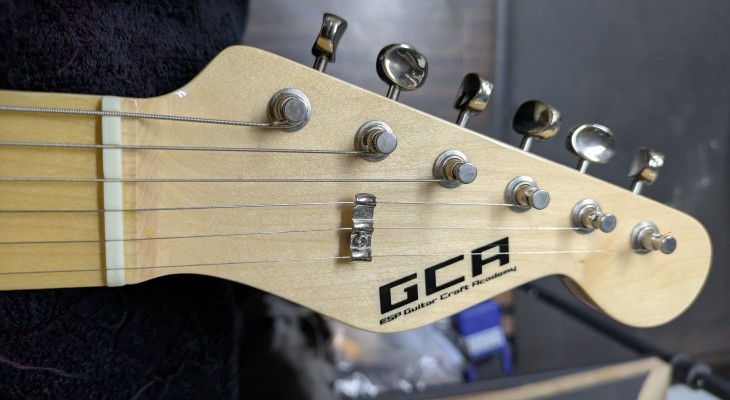
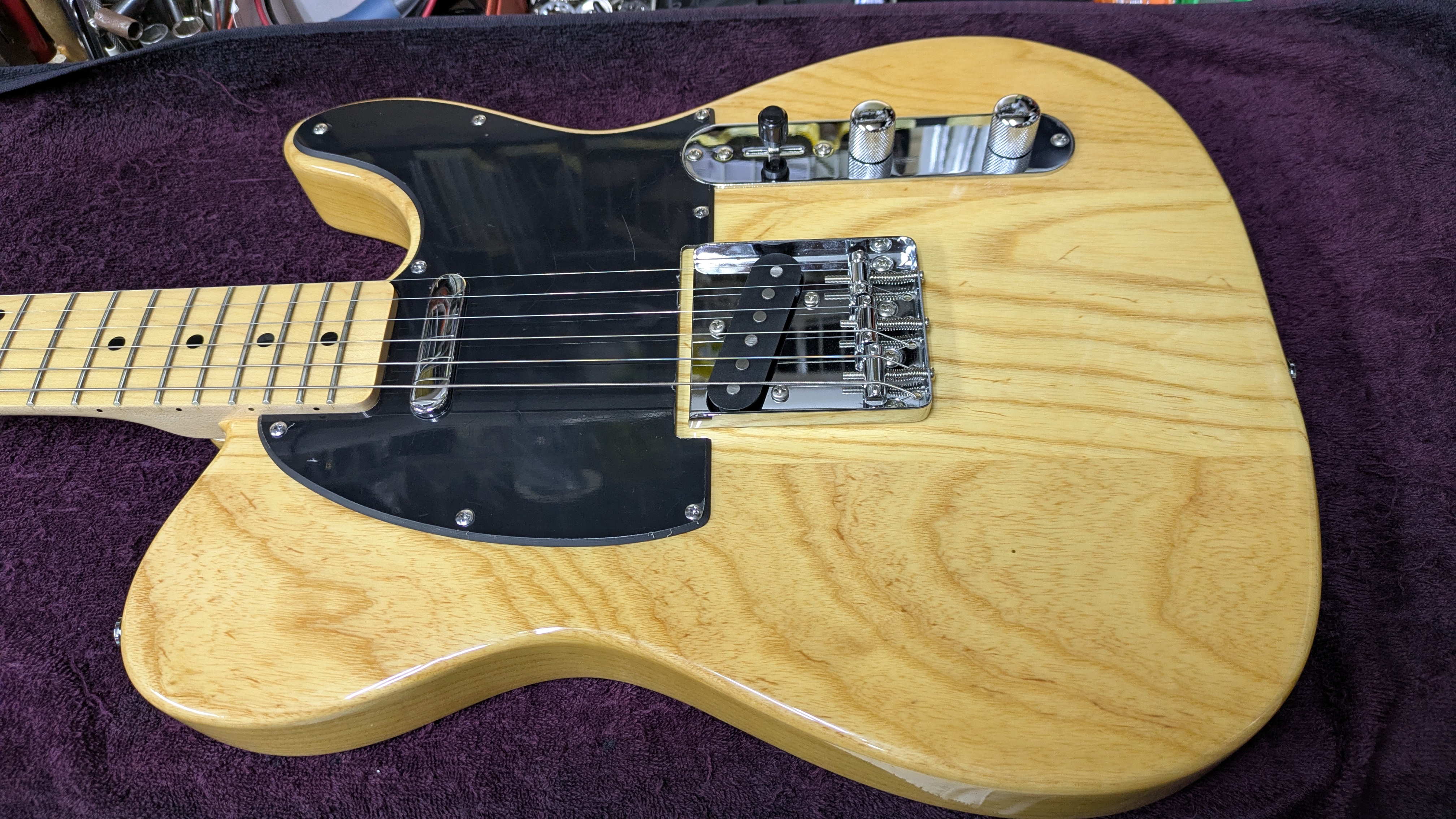
This is a guide to replacing the tension pins on the experimental Telecaster featured on YouTube.
The fact that “parallel-headstock guitars require a tension pin for the 3rd string” still hasn’t caught on at all among the general public.
As a result, there’s significant variation in tone, and chords sound bad.
Furthermore, the pressure on the 3rd string’s nut becomes extremely weak, so the open string doesn’t ring out fully—which only exacerbates the differences in tone between the strings.
To avoid this, a tension pin is needed for the 3rd string, but since most manufacturers lack technical expertise, very few have attempted to fix this issue.
Fender started installing tension pins on the 3rd and 4th strings in the 1980s, but it’s a mystery why they stopped doing so.
While a tension pin isn’t necessary for the 4th string, it is essential for the 3rd string.
In recent years, tension pins compatible with strings 1 through 3 have become available, and simply using these can significantly improve the sound.
The sound of the 3rd string becomes tighter and more resonant.
Simply put, the pressure on the nut—which the 3rd string previously lacked—increases, allowing the string to ring out fully and balance the tone with the other strings.
In particular, while the adjacent 1st and 2nd strings come with tension pins as standard and resonate fully, the 3rd string not only fails to resonate fully but also stands out negatively because it’s louder (due to improperly adjusted pole piece heights).
Since this issue with the 3rd string is completely eliminated, please replace your tension pins immediately with ones that work for the 3rd string as well.
They cost only about 1,200 yen, and this alone will improve the sound.
The tone will match that of the 1st and 2nd strings, and your chords will sound better.
You can see in the video how tension pins change the sound, but to be precise, what’s important is “applying the proper string tension to the nut.”
Please understand that this nut (contact pressure) is a major factor affecting the sound.
This also explains why the sound on Jaguar and Jazzmaster models can be poor; since the string tension on the bridge saddles is too weak, the strings don’t resonate fully, making a buzz-stop bar essential.
Remember that this contact pressure is essential for both the nut and the bridge; if it’s insufficient, the strings won’t resonate properly, leading to poor sound quality.
This is a pot replacement and setup for a S-brand Modern guitar.
The pots were producing a scratchy sound and had stopped working properly.
The neck was also bowing forward, resulting in high string action.
The truss rod didn’t seem to have much play left; while I was able to make the adjustment, the guitar likely won’t last long unless the strings are properly loosened when in storage.
Pots are consumable parts, so if you don’t replace them as soon as you hear that scratchy sound, they’ll eventually stop working altogether—which could lead to major issues when you need the guitar most, so please be careful.
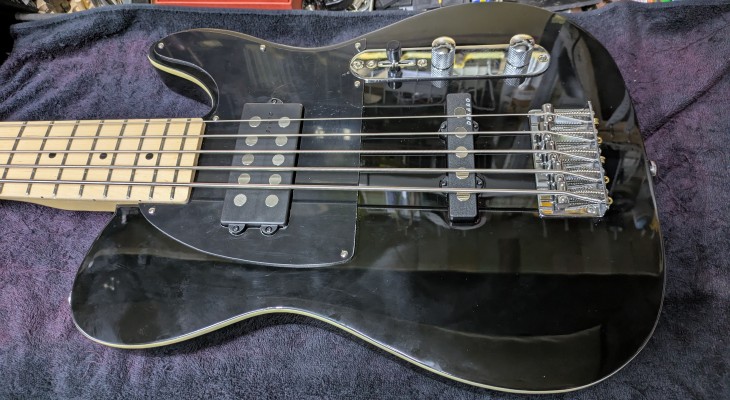
This is a pickup replacement and setup for a bass ordered and purchased on AliExpress.
We’re replacing the pickups with Delano pickups provided by the customer.
The front pickup fit right in, but it appears the routing is misaligned.
Additionally, since the pole piece spacing differs significantly from the original, the string positions and the Delano pickup are quite different.
The rear pickup is also misaligned from the centerline and doesn’t quite fit in size, so it won’t fit into the cutout as is.
Furthermore, the string spacing on the installed bridge is quite narrow at 16; given the width of the fingerboard, I think a bridge with a string spacing of around 18 would likely work just fine.
Although the pole pieces on the front pickup are significantly offset from the strings, I was surprised to find that each string was picked up without any issues when I actually played it.
The rear pickup’s mounting position was catching on my ear, so I had to shave down the body cutout slightly.
With the Delano rear pickup, even a slight misalignment reduces the volume, but I was able to balance the volume by raising the side near the 1st string significantly.
If the pickup is mounted too low, the rear pickup won’t pick up the sound properly, resulting in a large difference in volume between the strings.
The result was a rich, mellow sound—proof of just how good the Delano pickups are.
Also, the nut that came with it is in poor condition—the nut height is extremely high, the grooves are poorly cut, and there are large gaps.
On top of that, it’s made of a soft material, so when the strings are tensioned, the nut twists and looks like it’s about to crack at any moment.
This definitely calls for a nut replacement.
While I’m at it, it would probably be best to replace the bridge with one that has wider string spacing.
Other than that, there don’t seem to be any particular issues.
Even though AliExpress sells items you can order for rock-bottom prices, I think there’s a significant hit-or-miss factor.
It might be fine if you’re willing to spend money to fix these kinds of issues, but it’s certainly true that the low price is still appealing.